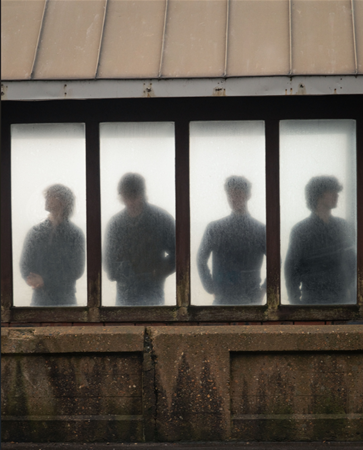
There’s a moment, right at the start of Jakobo, where a saloon‑bar piano clinks into life like someone nudging open a door to a dimly lit room. It’s a tiny gesture, but it tells you everything about where Die Twice are heading. This is a band unafraid of space, mood, or mystery — a four‑piece who understand that tension is often more powerful than noise.
Their new single, released independently via FAE, is the clearest expression yet of that philosophy. Jakobo drifts in on smoke and shadow, Billy Twamley’s guitar curling around Olly Bayton’s vocal like a whispered confession. The verses feel suspended in mid‑air, all spidery lines and half‑lit imagery, before the whole thing detonates into a chorus that hits like a sudden storm. Bassist Finn “Blue” Lloyd and drummer Jake Coles give it its heartbeat, its threat, its sense of something barely contained.
LISTEN HERE
Produced by Ru Lemer (Foals), mixed by Adrian Hall (Depeche Mode, Anna Calvi) and mastered by Nick Watson (Sea Girls, Warpaint), Jakobo is a study in restraint and release. Every element feels intentional, from the way Bayton’s voice flickers between breathy intimacy and full‑throttle howl, to the way the band let their arrangements breathe. It’s a striking reminder that “hold my beer” can, in the right hands, sound strangely tender.
Lyrically, Jakobo is a collage of fragments: messages to loved ones, glimpses of streets, tiny rituals of escape. Nothing is spelled out, yet everything feels emotionally precise. The song circles around instability — the kind that shakes your sense of self — and the stubborn refusal to compromise that often emerges in its wake. It’s a portrait of someone trying to stay upright while the ground shifts beneath them.
That sense of internal turbulence is mirrored in the music. Die Twice don’t rush to the payoff; they let the tension simmer, stretch, and twist. It’s a deliberate pacing that puts them at odds with the churn of modern music culture, where immediacy is often prized over immersion. Instead, the band build worlds — luxuriant, cinematic, and deeply felt — drawing threads from Serge Gainsbourg’s Histoire de Melody Nelson and the emotional sweep of The Bends‑era Radiohead.
Die Twice’s story begins in Exeter, where a series of chance encounters pulled Bayton, Twamley, Lloyd and Coles into each other’s orbit. What followed was a rapid rise through the city’s live circuit, culminating in 500‑cap sellouts achieved entirely under their own steam — a testament to word‑of‑mouth momentum rather than algorithmic luck.
Their relocation to Brighton last year has only sharpened that trajectory. Four consecutive sold‑out headline shows as part of their “Mosquito Nights” residency have cemented them as one of the city’s most compelling new acts, while recent tours with The Molotovs and Nieve Ella have introduced them to wider audiences already whispering that 2026 might be their year.
Socials