
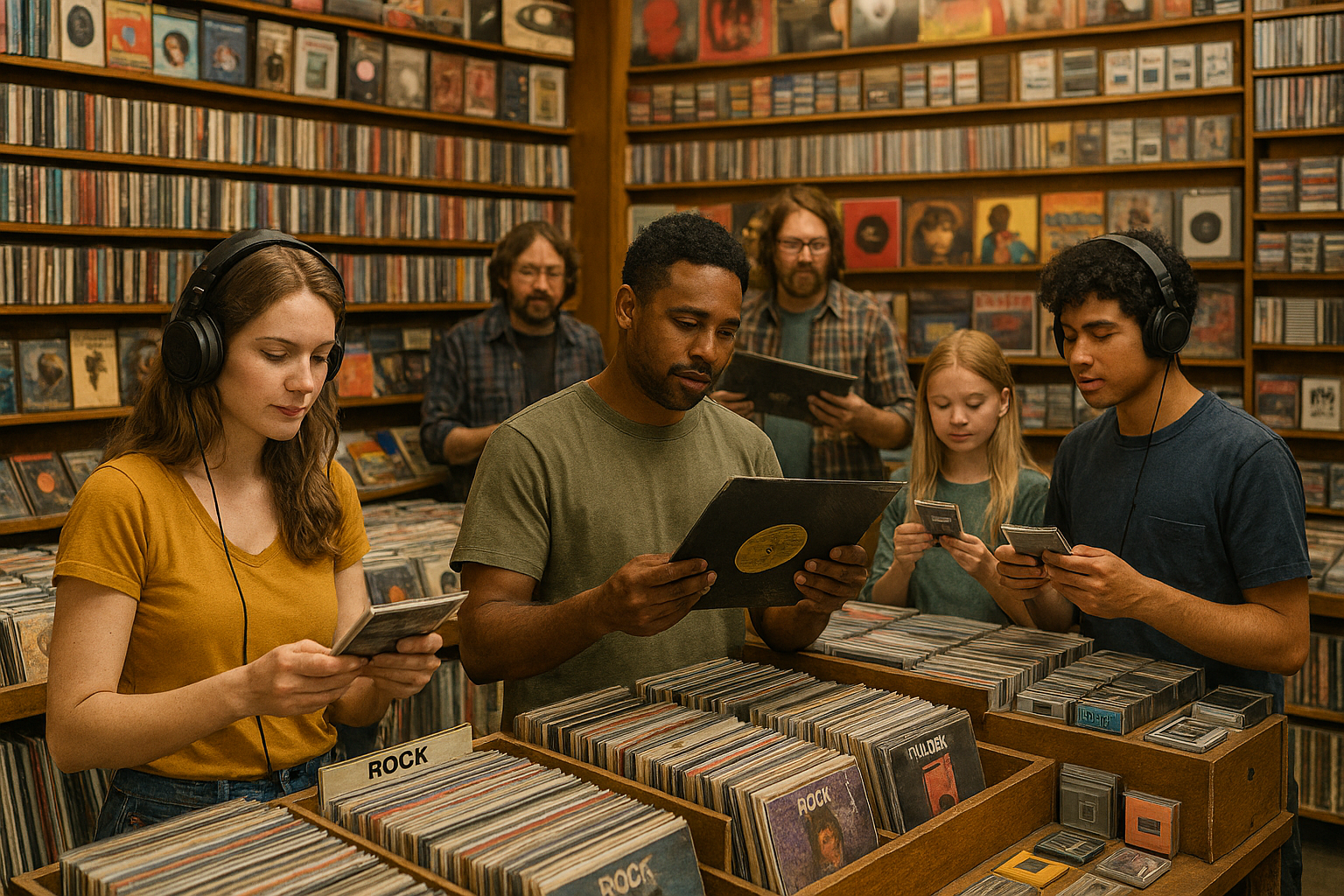
There was a time—not even that long ago—when the music industry seemed convinced that physical formats were done for. The digital revolution marched in with the swagger of inevitability: MP3s, iTunes, streaming platforms, cloud libraries. Convenience became king. Why bother with shelves of CDs or crates of vinyl when you could carry the entire history of recorded sound in your pocket?
And yet… here we are. Vinyl sales are climbing year on year. Cassette runs sell out in minutes. Limited‑edition CDs are suddenly desirable again. Even mini‑formats like flexi discs and lathe‑cuts are finding their way into the hands of curious newcomers. Something shifted—and it’s worth asking why.
For many of us who grew up in the 80s and 90s (including me), music wasn’t just heard—it was held. You didn’t just “add to library”; you slid a cassette from its case, studied the artwork, unfolded the liner notes like a treasure map. LPs were portals: oversized canvases that made the music feel bigger, bolder, more intentional.
Digital listening, for all its convenience, stripped away the ritual. It made music frictionless—but it also made it weightless. When everything is instantly available, nothing feels truly yours.
Even during the peak of the digital wave, there were always the die‑hards. The crate‑diggers. The Discogs obsessives. The people who refused to let go of the idea that music is an object, not just a stream of data.
These collectors weren’t being nostalgic—they were preserving a relationship with music that felt personal, tactile, and rooted in memory. And now, as younger listeners discover the joy of owning something physical, those once‑niche communities are becoming cultural forces again.
Most people aren’t choosing between Spotify and vinyl—they’re using both. Streaming is the radio of the modern age: instant, infinite, and algorithmically adventurous. But when a record matters—when it hits emotionally, historically, or aesthetically—people want to anchor it in the real world.
A physical collection becomes a map of your life. A shelf of stories. A biography told through spines and sleeves.
You can’t pass down a playlist to your kids. But you can hand them a box of records and say, “This is who I was.”
It’s easy to assume that vinyl’s resurgence is driven by nostalgia, but that’s only half the story. Many younger collectors never grew up with physical formats at all. For them, vinyl and cassettes are new, exciting, and—crucially—intentional.
In a world of infinite scroll, owning a record feels like an act of rebellion. It’s slow. It’s deliberate. It’s analogue in a digital age that rarely pauses.
And let’s be honest: a well‑curated shelf of LPs looks incredible in a bedroom or studio. Aesthetic culture has played its part—but it’s not the whole picture. Younger listeners are discovering the same thing older collectors always knew: music feels different when it has weight.
Because physical music offers something digital never can:
A sense of ownership
A deeper emotional connection
A ritual that slows life down
A community built around discovery, not algorithms
A way to support artists more directly
It’s not about rejecting the digital world, it’s about balancing it. A hybrid future feels inevitable, but the physical side of that equation is no longer the underdog.
Whether you’re a lifelong collector who remembers rewinding tapes with a pencil, or someone who just bought their first LP last week, I want to hear from you.
Why do you think physical music is making a comeback? Do you prefer the ritual, the artwork, the sound, the collectability—or something else entirely?
Drop your thoughts, stories, and hot takes in the comments. Let’s spark a debate worth having.