
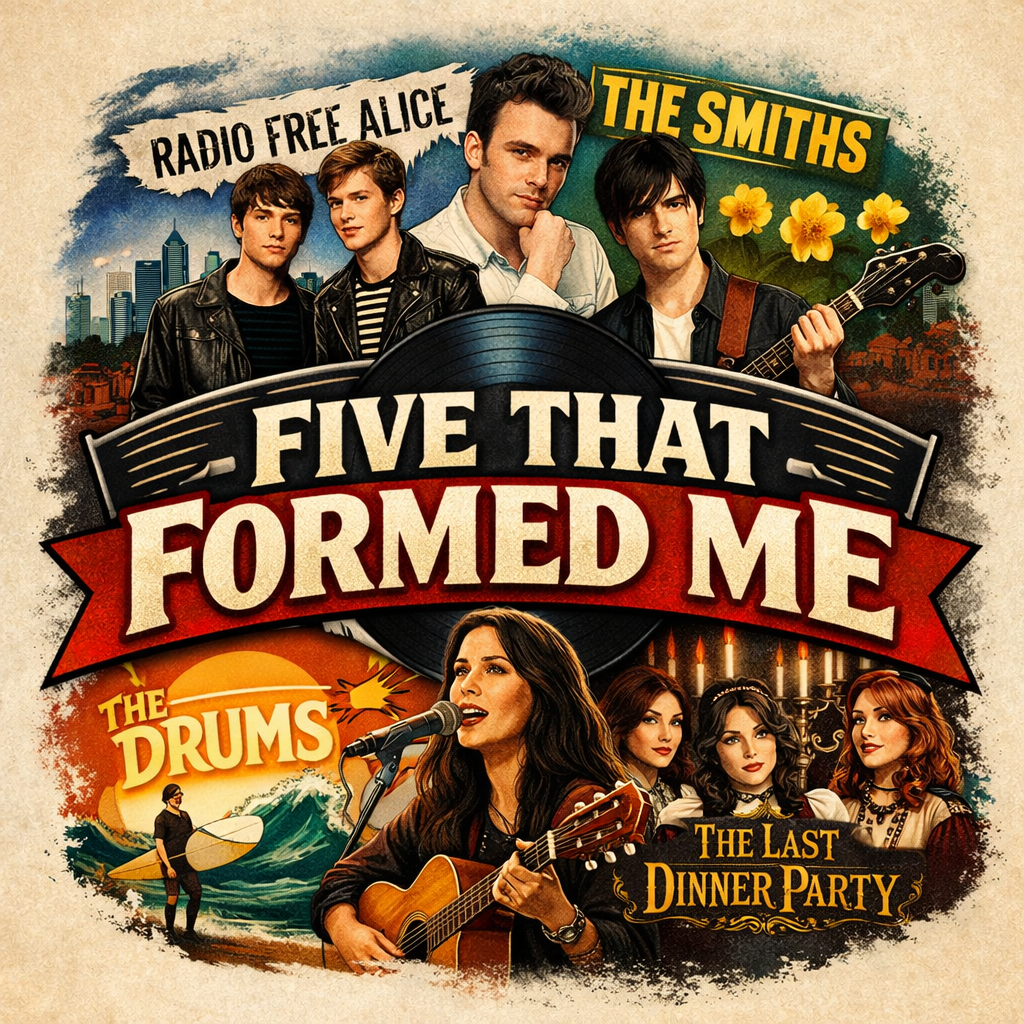
When Colour TV frontman Sam Durneen isn’t sweating through one‑day festival marathons or accidentally manifesting Shed Seven frontmen into existence, he’s obsessively dissecting the artists who shaped him. For the debut edition of Five That Formed Me, Sam sat down to talk through the five acts that moulded his songwriting, his worldview, and even the artwork on Colour TV’s debut EP.
What follows is a portrait of a musician shaped by melody, melancholy, brevity, emotional honesty, and a fascination with the tension between beauty and darkness.
1. Radio Free Alice
Radio Free Alice are the newest band on Sam’s list, and the one he’s currently most obsessed with. He discovered them about a year ago through Spotify’s DJ feature while driving with Colour TV bandmate Jack Yeo (guitar). Their first reaction was dismissive (“Nah, this isn’t for us”), but that knee‑jerk scepticism didn’t last long.
Over time, Sam became completely hooked. He describes them as occupying a post‑punk / new‑wave niche that aligns perfectly with the band he imagines in his head. “In a perfect world, we’d have written all their songs.”
He loves their sharpness, their speed, their melodic instincts, and their ability to keep songs tight and punchy. That brevity, two‑minute bursts of energy, has already begun influencing Colour TV’s own writing. He admits he’s always gravitated toward songs that “give you everything in the first 30 seconds,” and Radio Free Alice embody that ethos.
Sam also hears a subtle gothic edge in their sound, something he finds compelling. Although they’re Australian, he notes they avoid the surf‑rock or spaced‑out indie tropes often associated with the region. Instead, he hears echoes of Talking Heads, Crowded House, The Cure, and Joy Division, all bands he loves.
His favourite tracks shift constantly as he discovers new corners of their catalogue, but he name‑checks:
Regret (from Empty Words, 2025)
Toyota Camry
Empty Words
Rule 31 (standalone single)
Lunch Money (new album campaign)
He’s so invested he even has a question ready for the band: “Is there a better single than ‘Lunch Money’ on the new album?”
2. The Smiths
If Radio Free Alice are Sam’s current fixation, The Smiths are his origin story.
He discovered them around age 11 or 12, after hearing Please Please Please Let Me Get What I Want via a Horrible Histories parody and then from his mum. The effect was immediate and transformative. “It completely blew my mind… anyone can use their voice to express whatever’s going on in their head.”
Growing up as a melancholy, introspective kid, The Smiths felt like they were written specifically for him. He describes his childhood as “sepia‑toned,” and The Smiths slotted perfectly into that emotional landscape. “It does something to your brain chemistry.”
Sam believes The Smiths wrote “the best music on guitar ever” and that no band before or since has matched the combination of Johnny Marr’s musicality and Morrissey’s lyrical strangeness. He’s listened to every song “a million times,” to the point where he hopes he’ll forget them by age 67 so he can experience them fresh again.
He’s not a Morrissey fan today, but the band remains the biggest influence of his life.
A surreal full‑circle moment came when Colour TV supported Mike Joyce at a DJ set in Dartington’s Things Happen Here venue. Joyce watched their entire performance, gave them hugs, encouragement, and remembered them years later on his book tour. For Sam, it was “totally insane.”
He also cites:
Patti Smith’s Horses as an influence on The Smiths
The Monochrome Set as a key precursor
The band’s brief glam‑rock flirtation in their later period
Strangeways, Here We Come as an underrated masterpiece
The self‑titled debut as the album that speaks to him most
Chosen track: Jeane (B‑side to This Charming Man)
3. The Drums
If The Smiths were Sam’s musical religion, The Drums were his escape from the cult.
He discovered them around age 17–18 through the track Money, which opened the door to a band that blended Factory Records gloom with 60s surf‑pop brightness. Their early work, he says, feels like: “Factory Records meets Surfing in the USA.”
The Drums taught him something crucial: simplicity.
Sam admits he used to overcomplicate his lyrics and structures. Hearing The Drums’ straightforward, repetitive, melody‑first approach changed everything. Their influence is directly audible in Colour TV’s early single Billy Pilgrim, whose chorus was rewritten after Sam absorbed their ethos.
He even modelled the back cover layout of Colour TV’s debut EP on the back of The Drums’ debut album — intentionally and exactly. “I copied it — completely.”
He also loves the band’s emotional vulnerability, their minimalism, and the way they make sadness sound bright.
Favourite track: Skipping Town (from their self‑titled debut)
4. Joan Baez
This is the curveball in Sam’s list — but it’s deeply personal.
Last year, Sam went through a period where he immersed himself in folk music for emotional reasons. That journey led him to Joan Baez, whose records his younger brother collects. What captivated him wasn’t just her voice, but the emotional tension in her relationship with Bob Dylan — especially when she covered his songs.
Sam finds the friction between them “completely inspiring,” particularly when she sings lyrics Dylan wrote about her. He’s fascinated by the way their personal history bleeds into the performances.
Colour TV fans may not realise it, but Baez is already woven into their music: The closing sample on Wake Up, Sleep God is Joan Baez speaking in the Rolling Thunder Revue documentary. Sam chose a tender, bittersweet exchange between Baez and Dylan that loops at the end of the track.
Chosen track: Don’t Think Twice, It’s All Right (Dylan cover)
5. The Last Dinner Party
The final act on Sam’s list is The Last Dinner Party, a band he first encountered through the huge YouTube ad campaign surrounding their debut single Nothing Matters. As a musician himself, he couldn’t escape the hype, but it wasn’t until he saw them live at the Isle of Wight Festival that they truly clicked.
For Sam, that performance was a revelation. “It was like, oh — that’s how you do it.”
It was the last set the whole of Colour TV watched together before rushing off to play their own show, and the timing made the impact even stronger. He was struck by their energy, their command of the stage, and the sheer theatricality of their performance.
Musically, Sam hears influences from all over the map:
Kate Bush
David Bowie
Florence + The Machine (in their fan culture and visual aesthetic)
And most strongly: Suede
He’s quick to clarify that the Suede comparison isn’t superficial, it’s something in Abigail Morris’s yelping vocal quality, the sexuality, the glam‑rock abandon, and the swagger that reminds him of early Suede. “It’s an enormous compliment,” he says.
He also notes a 70s quality in their sound and presentation, even though the band themselves have pushed back against being labelled a glam revival. Their career trajectory, he says, mirrors Suede in another way: starting with something glam‑tinged before evolving into a more 80s new‑wave palette.
Sam also talks about the shift between their debut and sophomore albums. He found the debut more immediate, while the second album introduced a country‑tinged angle that initially threw him. But seeing the new material live changed everything, songs he didn’t think were hooky suddenly revealed multiple vocal hooks he couldn’t stop singing.
He describes being hypnotised by their Isle of Wight set, particularly by the freedom and physicality of their performance. “It’s difficult to be on stage and be that free.”
He also loved that they debuted a brand‑new, unreleased song with a “la‑la‑la” chorus that instantly reminded him of Suede’s Beautiful Ones. “That’s all you need — get thousands of people singing la‑la-la out loud.”
By the time they closed with Nothing Matters, Sam felt so connected to the rest of the set that he didn’t even need to stay for the crowd‑pleaser. “I’d been so transfixed by the magnetism of the rest of the set.”
Final Thoughts
Across these five acts, a picture emerges of Sam Durneen as a musician shaped by melody, melancholy, brevity, emotional honesty, theatricality, and a fascination with the tension between beauty and darkness.
From the gothic jangle of Radio Free Alice to the sepia‑toned introspection of The Smiths, the surf‑tinged gloom of The Drums, the folk‑poetry of Joan Baez, and the baroque‑glam ambition of The Last Dinner Party, these are the artists that formed him.
If this is the blueprint, it’s no wonder Colour TV sound the way they do.
Follow Colour TV