
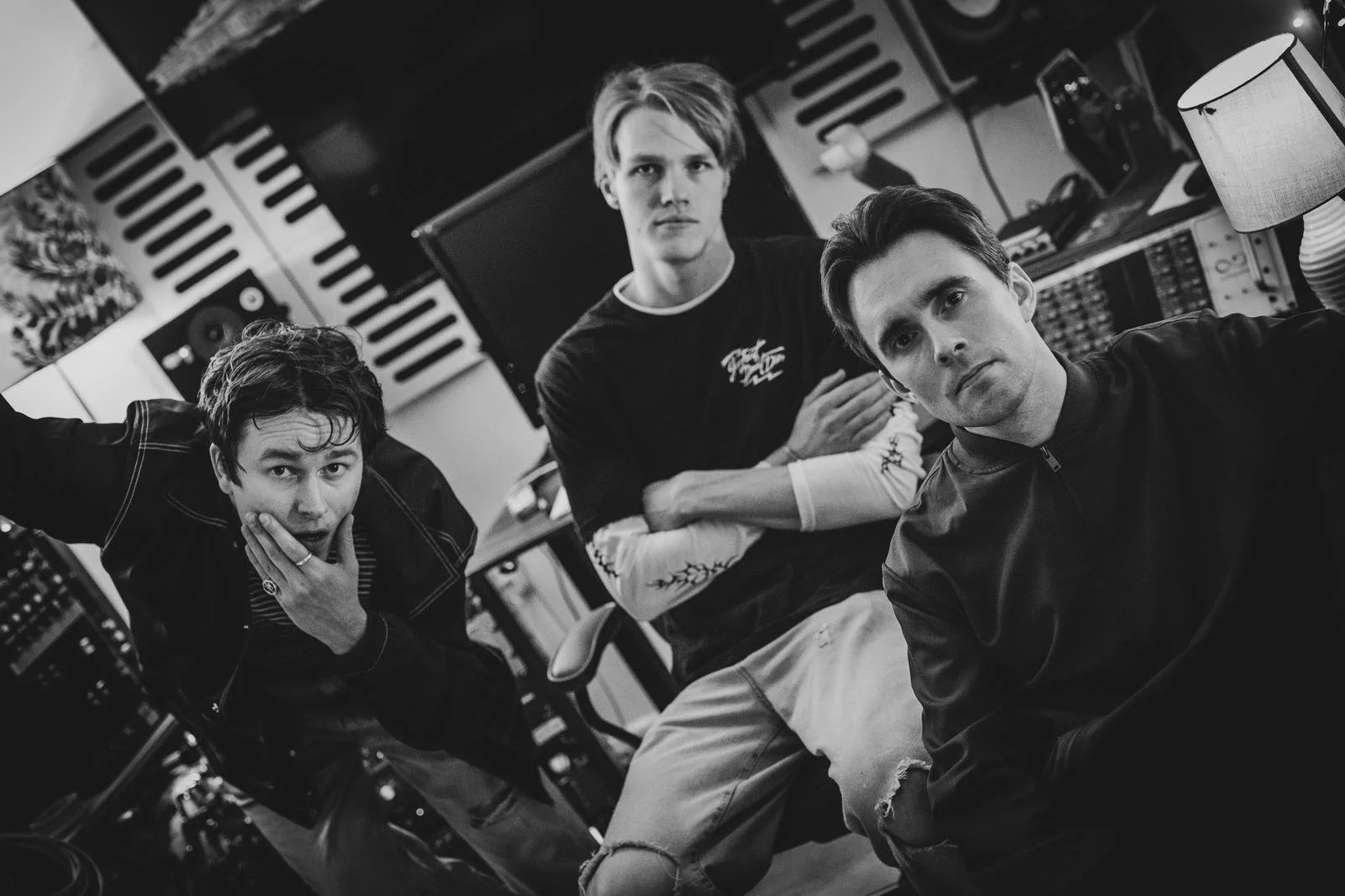
False Heads have never been a band to do things by halves. Whether it’s Jake Elliott locking in on bass even after going “arse over head” onstage, Charlie Gregory powering through drum takes with machine‑like precision, or Luke Griffiths pouring every ounce of energy into the songs he writes, the trio have carved out a reputation as one of the UK’s most fiercely committed alternative acts. With a decade of graft behind them, a charting second album, and a third record that Luke describes as their “best written and produced” yet, the band stand on the cusp of a new chapter — bigger, heavier, and more emotionally charged than anything they’ve done before. We sat down with Luke to talk origins, influences, chaos, growth, and the bleak beauty at the heart of Oldest Part of Hell.
For readers discovering you for the first time, can you introduce the full lineup — and tell us what each of you brings to the False Heads identity, both on stage and in the studio?
Jake Elliott (bass) is always locked in onstage and recovers instantly (even after falling arse over head on stage once) from anything thrown his way, in the studio Jake is very efficient at coming up with ideas to finish a part of a song off (piano or guitar parts) and is great at cutting out anything that's not necessary.
Charlie Gregory (drums and backing vocals) probably one of best drummers I've seen live, so extremely lucky to have him. Brings immense energy and is as tight as fuck. In the studio he's just an absolute machine - not sure I’ve ever seen him need more than three takes for a track.
Luke Griffiths (vocals guitar) I like to think I leave everything on stage and give as much energy on stage as it took for me to bring the songs to life when writing it. In the studio, I just think I can roll with the punches if needs be and just smash it out without too much faff.
You’ve been carving out your place in the UK alternative scene for a while now — how long have you each been making music, and what were those early beginnings like? Was there a moment where you realised this band was going to be your life’s work?
I've been making music in some way for 15 years, since I was a kid. It's been serious for about a decade. Early beginnings were fun and frustrating. I wasn't exactly a naturally gifted guitarist or singer, but I felt like I had a natural knack for writing tunes and lyrics, so that came with challenges, but at the same time, it was quite fun working those things out.
Early gigs, playing to nobody are also hard to take, but will tell you if you’re cut out for it. In terms of one moment where I knew I'm not actually too sure…. I just knew I loved writing songs more than anything I'd ever done before and wanted to do it forever.
False Heads have played with The Libertines, Josh Homme, Band of Skulls, David Byrne and Frank Turner — that’s a wildly eclectic list. Which artists or scenes have genuinely shaped the DNA of your sound, and how do those influences show up in the music you’re making today?
Well I was into hip hop and grime first which I think at times seeps through especially in me keeping my natural accent.
After that I'd say the first 5 artists I was properly obsessed with were Nirvana, Radiohead, Bob Dylan, Pixies and Elliott Smith. I think they still shine through but after a period of time you do forge your own sound. I'd like to think we've done that.
Your second album Sick Moon, produced by Frank Turner, landed you in the UK Official Album Charts and hit number 2 on the Independent Album Breakers Chart. What did Frank bring to the recording process, and how did his perspective shape the final sound of the record?
He was still pretty new to producing, and we recorded it at his house, so we threw loads of ideas at the songs. He’s a songwriter first and foremost, and I think that comes through more on that record.
The whole process was pretty fucking chaotic. Jake broke his arm, then we got Covid halfway through and had to start again.
Some of the songs feel a bit undercooked to me like “Doll’s Eye..” because Covid meant we couldn’t tour our first record at all, we ended up writing loads but couldn’t jam together as much. We probably didn’t get to put the songs through the refining process we normally would. That's fine though, you can't go back and over analyse your own stuff too much.
You’re a London outfit — how would you describe the current music scene in your corner of the city? Is it thriving, fragmented, competitive, collaborative? What’s exciting you about the artists coming through right now?
I mean to be perfectly honest, the last two years we haven’t done much gigging, we've been writing and recording our third album so haven’t got our finger on the pulse too much.
It feels a bit unaccessible to me as time has gone on and it seems very kinda posh. I'm a bit bored of hearing that accent to be perfectly fucking honest!
I don't really take too much notice of ‘scenes’ if I'm honest. They’re often fleeting. I'd just knuckle down, write and record and play gigs where you can if I was a band in London, I think you'll find your people.
You’ve attracted fans ranging from Simon Le Bon and Iggy Pop to legendary manager Danny Fields. What’s it like knowing your music resonates with people who helped define entire eras of rock culture? Does that change how you think about your own legacy?
Yeah it's amazing. It's always good to be supported by your peers who have done it and have been around so much music and created so much.
There's not many living people in music I respect more than Danny Fields or Iggy Pop.
Your track Rabbit Hole has passed 1.5 million streams, and you’re already deep into album three with Grammy‑winning producer Adrian Bushby. What can you tell us about the new material — sonically, emotionally, or thematically? Where is False Heads heading next?
Yes, well we've finished it finally. I think it's a huge step up. Adrian is just a phenomenal producer and the sound is so full and huge.
We also brought in full string sections in some of the songs by a good friend Steven Bentley Klein so it's definitely got different elements. It’s the best written and produced album we have made so far.
Lyrically, it's similar to the first two but things are obviously getting worse and worse in the world and the lyrics do become bleaker. I was also optioned by a production company to write a TV show about my family which I think is reflected in the album too - mediations on generational trauma, free will and the almost impossibility of escaping what you're born into but how some people do.
Your new album is titled Oldest Part of Hell — it’s a striking, loaded phrase. What does that title represent for you emotionally or thematically, and at what point in the writing process did it reveal itself as the right name for the record?
Well something I've always done by default is write lines that reflect how I see the world/how the world makes me feel but also how I feel personally and Oldest Part of Hell just seemed to be the perfect line for that.
The Oldest Part of Hell for me is my life long battle with depression which when I sink into it it's hard to come out of. The world is just also falling further into radicalisation, stupidity and I really am struggling to get away from the idea that the average person is a divvy cunt, becoming more proud of it and the world that is emerging is sort of encouraging and rewarding that and what I think is coming from that is going to be a sort of global misery and depression we might not be able to shake out of.
My experience with depression is that it often follows feelings of extreme rage. That's what I see happening in the world. This rage that is building can only last so long. Its cyclical. I don't know what the world will look like in 15 years, but I think its going to be miserable.
Where did you record Oldest Part of Hell, and what drew you to that particular studio environment? Did the space itself influence the sound or energy of the sessions in any noticeable way?
We recorded it in Essex at Adrian's studio. I'll be totally honest, I don't think it really did. We had really got the songs down, spent a lot of time on them and demoing them, so when we went in, we really just smashed them out.
What made him the right person for record number three, and what did he unlock in your sound that you hadn’t tapped into before?
The fullness and hugeness of the sound, definitely. Everything sounds exactly how I wanted it to. When you're a three-piece, getting that fullness is what you need to fill the space. Adrian did that in spades. He's great at throwing little ideas in to just make things fit together. "Leader for Now" is a great example of that. The last chorus into the outro just wanted seamless, and Adrian added literally one chord, and it worked immediately.
Third albums can go either way — some bands say it’s easier because they’ve found their identity, others say it’s harder because expectations rise. How did the process feel for you this time around? Was Oldest Part of Hell a smoother ride or a tougher climb?
The stuff in the background was tough. Our joker of an ex-manager was trying to rinse us for money. We changed virtually our whole team because it wasn't quite working for us, so it also added to why it took us a bit longer to get this record going. Having said that, once we had the songs and rehearsed them, we were confident that they were strong. Having someone like Adrian, who's won Grammy awards and is so experienced, is a good yardstick to have because if he is on the same wavelength as you when it comes to the quality of the songwriting, you can be confident it's moving in the right direction.
False Heads have always had a reputation for being hands‑on and fiercely involved in shaping your sound. How deep were you in the recording process this time — were you experimenting, co‑producing, obsessing over details, or trying to step back and trust the room?
Yeah, we definitely stepped back and let Adrian do his thing, but because we did an EP with him (which will be part of this album), we knew how he worked and he knew how we did, so we just sort of rolled with it. I normally do most of the obsessing when I'm writing the tunes and the lyrics, so I kind of like to have trust in the producer after that. That's his expertise, and if we respect each other, then we know we both just want the best for the record.
There's always a few bits in the mixing stages that need tweaks or changes but that's pretty normal. We were just well prepared for this record so it was seamless really.
Are there any tracks on Oldest Part of Hell that you’re particularly excited — or nervous — to unleash live for the first time? What makes those songs feel like they’ll hit differently on stage?
Probably the title track Oldest Part of Hell... definitely need to work out how to make that fucking string section work live
Come Dine With Me time — if the three of you were hosting the ultimate band dinner party, what would you serve for starter, main and dessert, and who would cause the most chaos in the kitchen?
Oh mate fuck knows. I went vegan this year so guests will have to like it or lump it. All I know is I'm ordering in Tofu-vegan and serving it up. That'll convert everyone. Charlie would be the handiest in the kitchen though. Everything would get sorted double quick.
If you could curate your dream festival lineup — any artists, dead or alive — who’s on the bill, and why do those acts matter to you personally or creatively?
Elliott Smith, Nirvana and the Beatles probably. I'll just go through headliners otherwise I'll be here all day.
I've seen Pixies and Radiohead otherwise they'd be on there. I just think those three have the greatest melody writers in the last 65 years and we really do miss good melodies in modern pop music. It's dire.
You’ve built a reputation as an incendiary live band. After playing alongside names like Frank Turner, David Byrne and Josh Homme, what’s the biggest lesson you’ve learned from watching other artists side‑stage that’s changed the way you perform?
I wouldn't say anything has changed in the way I perform, but it has reaffirmed it. The philosophy I've gotten from the top performers we've played alongside is to give as much energy as you can without it being in-authentic and revel in the fact that you've written music that has put you on stage in front of hundreds, thousands of people. Rehearse, be tight, but also leave it all out there. Like fucking Bobby Moore.
And finally, would you rather be permanently locked into playing 500‑capacity sweatbox venues where the crowd goes absolutely feral every night, or graduate to arena‑level shows with huge production, massive sound and global reach?
Either is fucking fine by me!
Huge thanks to Luke for taking the time to chat with us and for offering such an unfiltered, thoughtful look into the world of False Heads — from early frustrations and feral gigs to full string sections, generational trauma, and the fight to keep pushing forward. With Oldest Part of Hell ready to make its mark, and Adrian Bushby helping the band reach the “fullness and hugeness” they’ve always chased, it feels like False Heads are stepping into their sharpest, most fearless era yet. We’re wishing Luke, Jake and Charlie every success as the new record rolls out, and we can’t wait to see these songs erupt onstage soon.
Socials