
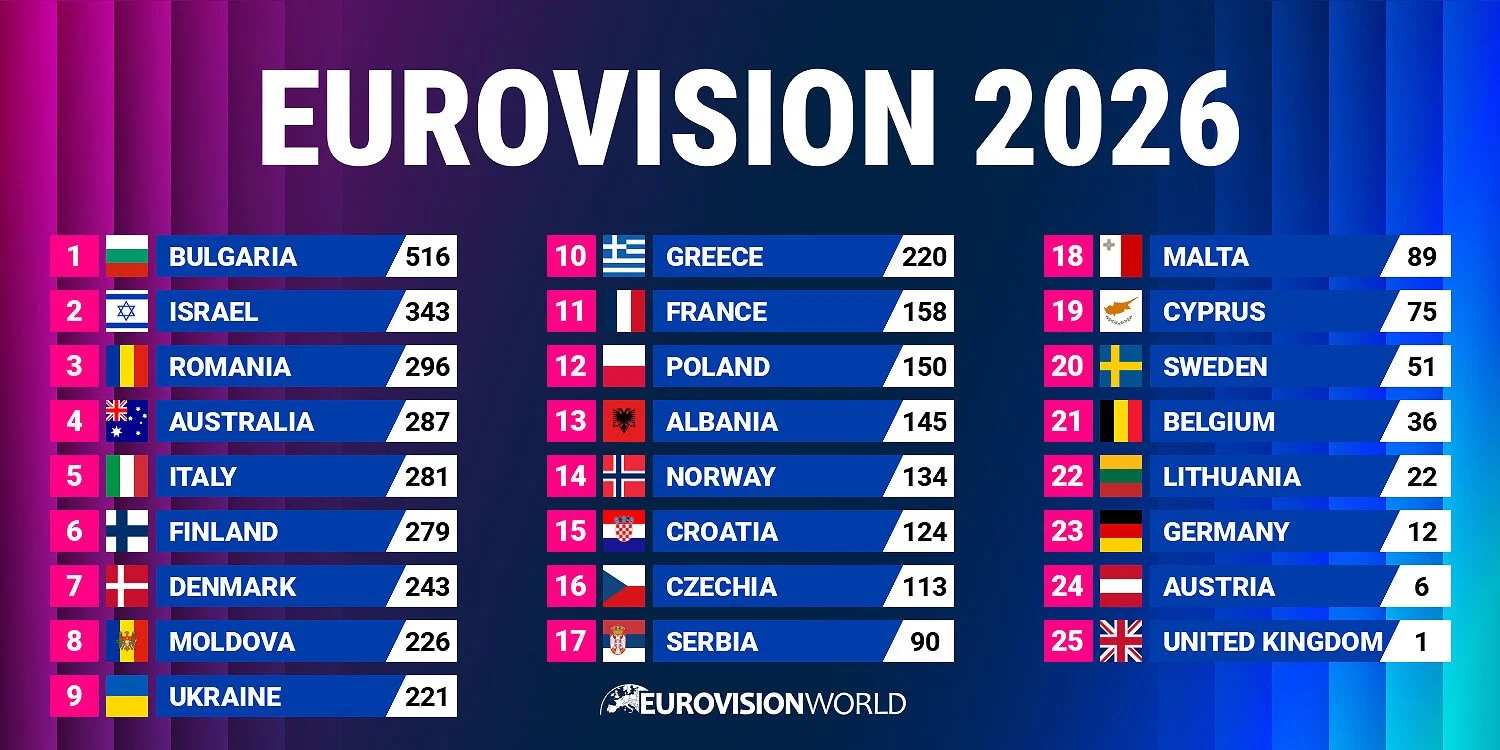
Another year. Another last‑place finish. Another night where the UK sits in the green room looking like someone’s nan dragged them to a rave they didn’t want to attend. Eurovision 2026 didn’t just go badly — it went predictably badly. And that’s the real embarrassment. So let’s stop tiptoeing around it. Let’s say the quiet part out loud.
Every time the UK tanks at Eurovision, the same excuses get wheeled out:
“It’s political.”
“It’s Brexit.”
“Europe hates us.”
“We’re the victim of bloc voting.”
But here’s the uncomfortable truth:
Europe doesn’t hate the UK. Europe just doesn’t care about the UK’s entries. We keep sending songs that feel like they were written by committee, polished by a marketing intern, and staged by someone who last watched Eurovision in 2003.
Meanwhile, other countries are sending:
Bold pop anthems
Queer‑coded cultural statements
Hyper‑theatrical performances
Artists who actually want to be there
We send… a nice person with a nice voice singing a nice song that nobody remembers by the second chorus.
Let’s kill the Brexit myth.
Eurovision is run by the EBU, not the EU. Australia takes part. Israel takes part. Azerbaijan takes part. Being in the EU has nothing to do with it. The real issue? The UK still treats Eurovision like a joke, while Europe treats it like the Champions League of pop. We roll our eyes. They roll out million‑euro staging budgets. We send “radio‑friendly”. They send “arena‑shaking”. We act embarrassed to be there. They act like it’s the biggest night of the year.
And Europe votes accordingly.
Here’s where the narrative gets messy — because the UK can do well when it actually tries.
Sam Ryder (2022)
A modern pop song, a charismatic performer, staging that didn’t look like it was filmed in a leisure centre — and suddenly the UK finished 2nd. Europe didn’t hate us then.
Jade Ewen (2009)
A powerhouse vocalist, a strong Andrew Lloyd Webber ballad, and a polished performance. Result? 5th place. Proof that quality still cuts through.
Blue (2011)
A legacy act with name recognition, a catchy chorus, and a performance that felt like it belonged on a big stage. They landed 11th, which for the UK in the 2010s was practically a national holiday.
Jessica Garlick (2002)
A classic Eurovision ballad delivered with confidence — and the UK finished joint 3rd. No politics. No excuses. Just a good song.
Even 2017’s Lucie Jones
A beautifully staged ballad, strong vocals, and a respectable 15th place — which, again, shows that when we take staging seriously, Europe responds.
Eurovision rewards:
Identity
Ambition
Spectacle
Risk
The UK rewards:
“Safe”
“Polite”
“Middle‑of‑the‑road”
“Won’t offend the BBC’s Saturday night audience”
We’re not losing because Europe hates us. We’re losing because we’re scared to be interesting.
There are three brutally honest options:
1. STAY AND STOP WHINGING
If we’re going to keep entering, then enter properly. No more apologetic pop. No more “this will do”. Send something with teeth.
2. WITHDRAW AND SAVE FACE
If we’re genuinely this embarrassed every year, then walk away. Stop funding a contest we clearly don’t respect. Let someone else take the Big Five slot.
3. REBUILD AND COME BACK SWINGING
The option nobody wants to admit is the most sensible. Create a proper national selection. Let artists lead the process, not TV executives. Invest in staging like it actually matters. Treat Eurovision like the cultural juggernaut it is.
The UK’s Eurovision problem isn’t political. It isn’t Brexit. It isn’t Europe. It’s us.
We’re terrified of looking silly, so we play it safe. But Eurovision rewards the silly, the bold, the weird, the emotional, the unapologetically extra. Until we embrace that, we’ll keep finishing last — and we’ll keep blaming everyone but ourselves.
Should the UK:
Stay and fight
Withdraw completely
Rebuild and take it seriously
Or is Eurovision simply holding up a mirror to a country that’s lost confidence in its own creativity?