
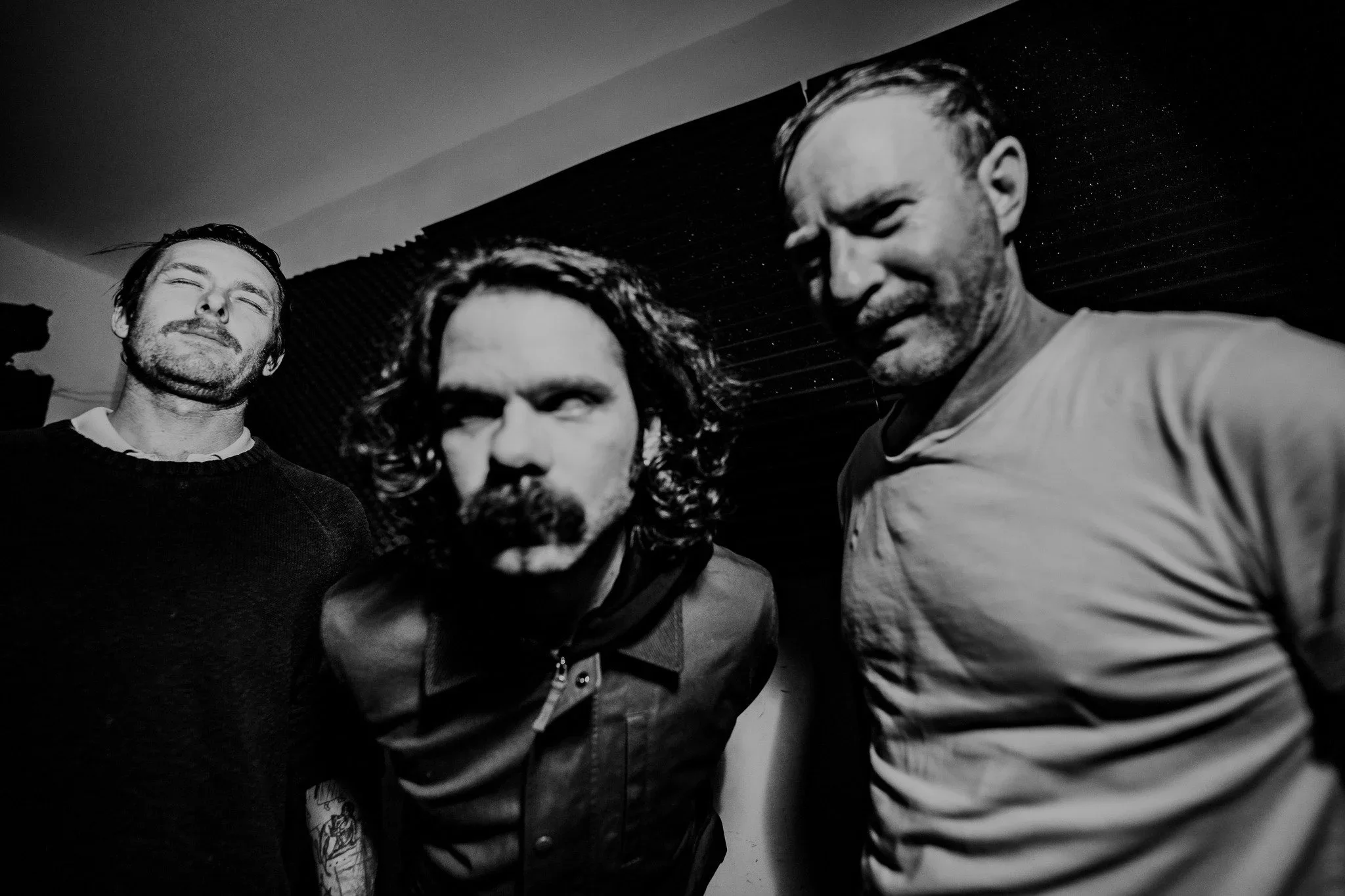
NORMANS aren’t a band that arrived fully formed — they emerged, almost accidentally, from late‑night conversations on a battered boat in Marina del Rey, from exotica deep dives, from chaos, discipline, and the urge to turn everything up just a little louder. What began as a quarantine distraction quickly revealed its own gravity, pulling Matthew Reid, Michael Perry Rudes and Kyle Souza into a project that feels physical, intentional and defiantly alive. Their new album Faust Demonica pushes that intensity into sharper focus: a record shaped by self‑remembering, subconscious expression and the strange, shifting landscape of Southern California’s underground. In conversation, they’re wry, reflective and occasionally philosophical, the kind of band who’ll cite Gurdjieff, complain about TikTok venues, and casually reveal aristocratic lineage in the same breath.
What was the moment you realised this collaboration had its own identity and needed to become a project in its own right?
Mike and I had taken up working on this shitty boat in Marina del Rey during the quarantine times. We spent a lot of time fishing, getting stranded at sea, and talking about music. We were both really on an exotica kick: Eden Ahbez, Martin Denny, Les Baxter—weird sort of '60s tropical stuff. Anyway, the plan was to make a kind of new-school exotica-sounding record, which we did record a few tracks of, but we found ourselves turning up the volume more and more when we would get in the rehearsal room. NORMANS was always there waiting to come out. At least that's how I see it.
Your music feels incredibly disciplined and physical. How do the three of you work together in the studio—is it structured, chaotic, ritualistic, or something in between?
The first record was pure chaos. I did absolutely everything myself, and it drove me nearly insane. This record, we were very fortunate to work with some talented professionals in some amazing studios. There is no glory in grinding it out alone. Let people have their say, trust the process, and believe what's being brought forth naturally is the right thing. That's my advice.
Critics describe your sound as spanning 1979 to 2024. Which artists, movements, or non-musical influences genuinely shaped Faust Demonica?
Being in a band and making a record in 2026 is an insanely banal endeavor. The sheer volume of artists and content being generated is nothing short of mind-blowing. Four hundred million terabytes of data is created every day, and with AI that number is sure to go even higher.
That being said, the only real way to derive any satisfaction from this world is to genuinely feel that you have expressed yourself. The record is honest, intentional, and reflects the way our band sounds right now. That's the long-winded way of saying our own chemistry would be the real influence.
Other people might say Depeche Mode.
The album draws on Gurdjieff's Fourth Way and esoteric traditions. How did those ideas filter into the songwriting, symbolism, or atmosphere of the record?
This is a big one for me, and I'll do my best not to sound preachy. Like I mentioned before, being in a band, being an artist, or just being a fucking human being right now comes with a lot of added complexity. You see too much, you feel too much, you think too much.
You are not going to change the world or where things are headed, but you can change the way you interface with it.
The book Beelzebub's Tales to His Grandson, or An Objectively Impartial Criticism of the Life of Man was very inspirational to me. It's about increasing awareness in everyday life, as well as seeing and transforming mechanical habits. Many of the songs on this record are written from a sort of Fourth Way, self-remembering perspective. Perspective is art's greatest power, turning individual experience into shared understanding.
If you could curate your own three-day mega-festival, which bands or artists (alive or dead) would you choose to headline each night, and why do they represent the spirit of Normans?
Mozart, Rammstein, Eden Ahbez.
Mainly just to see who would show up.
Are there particular Southern California venues, scenes, or communities that played a meaningful role in shaping NORMANS' early identity?
That's an interesting area of discussion at the moment. Ten years ago, in East L.A., on any given night you could find several amazing shows with great crowds and excellent music. It was always a party.
Since COVID, things have really dropped off—not just in average crowd size, but a lot of the venues were purchased by large corporations that cater to the new TikTok and YouTube acts.
Maybe it's just my generation aging out of going to shows a few nights a week, or a general lack of interest in heavier music, but it's certainly a changing landscape.
Venues like Permanent Records Roadhouse, Zebulon, and Non Plus Ultra have been crucial in keeping the scene alive in our neck of the woods.
Your sound is tightly unified, but do you actually share similar musical tastes, or is the tension between your influences part of what drives the project?
We all have our own preferences musically, but one thing we do share is a certain attitude when it comes to the way the music comes off. We want maximum impact.
People need to feel it.
Faust Demonica feels more precise and deliberate than your earlier work. What changed in your approach to production, writing, or intention this time around?
Like I mentioned before, working with other people made it much easier to focus on the core intention of the song rather than the technical aspects that can really bog you down and hijack your focus.
The single "Mexico Unlimited" is fast, hypnotic, and unrelenting. What was the spark behind it, and what does it reveal about the wider world of the album?
That track goes way back to when Mike and I would jam in the garage with just drums and a bass. I wrote the lyrics the same night.
They were supposed to be sort of dumb and silly, but looking back, they hold up and say a lot more than I might have intended at the time. Never underestimate the power of subconscious expression.
With the album landing on June 5th, what does the rest of 2026 look like for NORMANS—touring, visuals, collaborations, something unexpected?
We've been enjoying these sort of targeted mini-tours. Last year we did several shows just in Texas, and it was awesome. So I imagine there will be more of that, as well as some European dates at some point.
What's one thing about the band, or a band member, that fans wouldn't expect but should absolutely know?
Mike is an unrecognized heir to the 12th Duke of Devonshire.
This is how we finance the majority of our records.
Finally, would you rather have X-ray vision or the power to travel through time? How would you use these powers?
I'm going to go with time travel so I can go back and tell myself not to watch the 2024 Alex Garland film Civil War - It was a terrible movie.